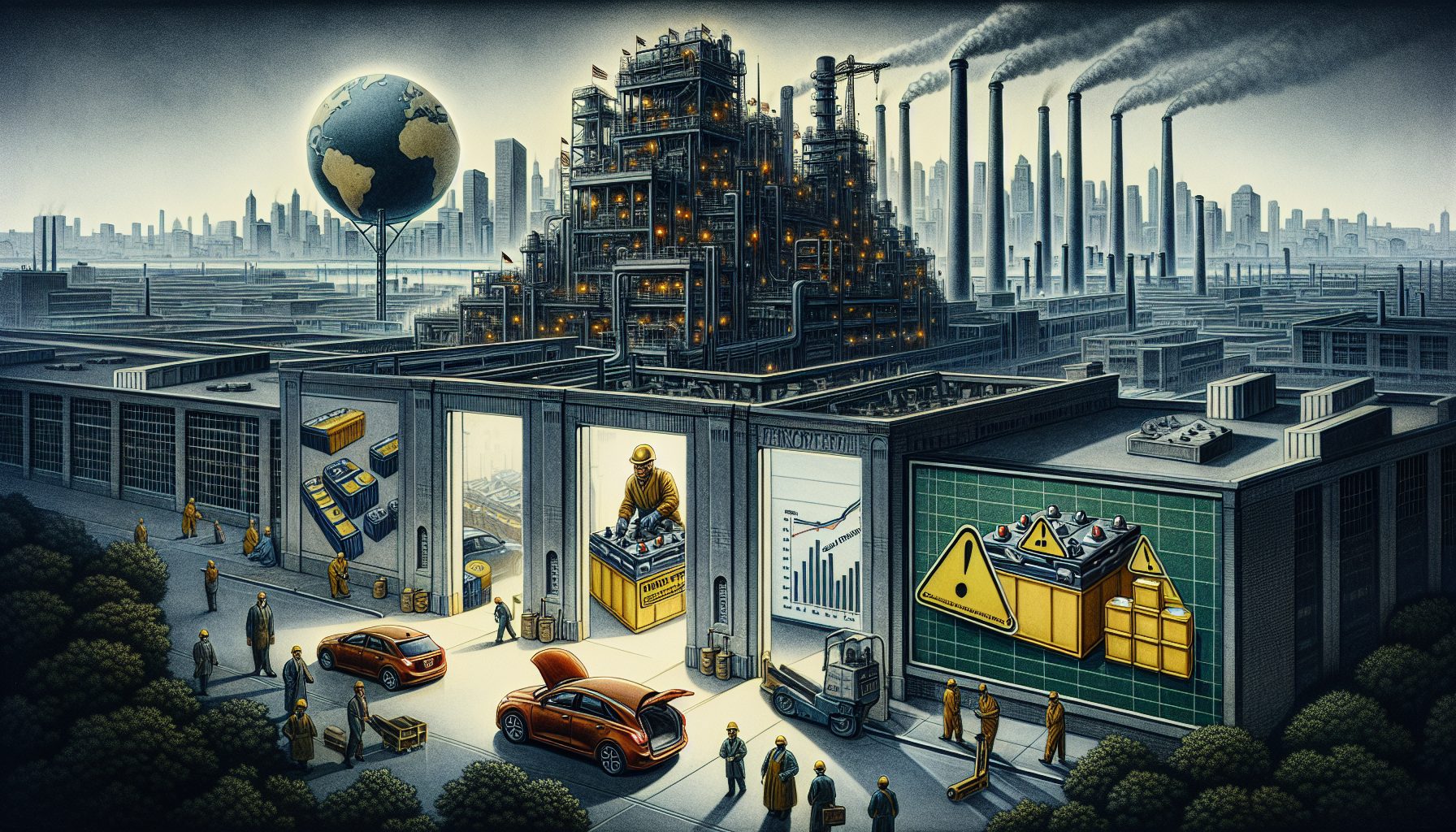
The Silent Crisis: Car Batteries and Economic Stability
The automotive industry, a cornerstone of global economic stability, has long been warned about the environmental and health hazards posed by car batteries. Yet, despite these forewarnings, the sector’s persistent negligence threatens not only public health but also the broader global economy. Economic stability, defined by the absence of excessive fluctuations (Economic stability – Wikipedia), is at risk as the ramifications of this oversight ripple through global markets.
Bridging the Gap: Economic and Environmental Concerns
As the electric vehicle (EV) market expands, the demand for larger batteries increases, further straining supply chains for critical minerals (Global EV Outlook 2024). This surge in demand is not without consequence. The environmental degradation from mining these minerals and the eventual disposal of electric batteries contributes to a cycle of unsustainable practices. These practices are not a distant threat but a present reality, with interconnected environmental, economic, and social systems facing long-term impacts (What Are the Long-Term Effects of Unsustainable Practices?).
Regulatory Reforms: A Necessary Intervention
Recognizing the urgency of the situation, governments and international bodies are implementing regulatory reforms. The European Union’s 2025 automotive regulatory changes are reshaping industry dynamics, offering new investment opportunities while promoting sustainability (The EU Automotive Regulatory Reforms). Similarly, the introduction of the Environment Protection (End-of-Life Vehicles) Rules, 2025, by India’s Ministry of Environment, marks a significant step towards environmental sustainability (REFORMING AUTOMOTIVE SECTOR – Waste Management Rules…).
However, these regulatory efforts highlight a fragmented policy landscape that businesses must navigate (BCG Asks: Has Sustainability Become Unsustainable in 2025?). This fragmentation can undermine long-term sustainability investments, as firms may prioritize short-term resilience over sustainable practices. The challenge lies in harmonizing these regulations to ensure that economic and environmental objectives are aligned.
Global Trade and Geopolitical Ramifications
The geopolitical implications of the auto industry’s oversight cannot be overstated. As nations vie for control over critical mineral resources, tensions may rise, leading to potential conflicts. This competition can disrupt global trade, further destabilizing economies already grappling with the repercussions of unsustainable practices.
Moreover, the transition towards electric vehicles, while reducing dependency on fossil fuels, introduces new dependencies on mineral-rich countries. This shift necessitates robust international cooperation to manage resource distribution equitably and sustainably. Failure to do so could exacerbate geopolitical tensions, as countries leverage their mineral wealth for strategic advantage.
Long-Term Societal Impact
The societal impact of the auto industry’s negligence extends beyond immediate economic and environmental concerns. As the consequences of unsustainable practices become more apparent, future generations will inherit a world grappling with ecological degradation and economic instability. The interconnectedness of our global systems means that actions taken today will have lasting impacts on societal well-being.
In response, there is an urgent need for the auto industry to adopt sustainable practices and for policymakers to enforce stringent regulations. By doing so, we can mitigate the long-term societal impacts and pave the way for a more stable and sustainable future.
Conclusion: A Call for Sustainable Action
The auto industry’s oversight regarding the hazards of car batteries serves as a stark reminder of the complex interplay between economic stability, environmental sustainability, and geopolitical dynamics. As economists and financial professionals, it is incumbent upon us to advocate for comprehensive solutions that address these challenges holistically. By fostering collaboration between industry stakeholders and policymakers, we can ensure that the path to sustainability is not only achievable but also beneficial for the global economy and society at large.
Works Cited
– Economic stability – Wikipedia. https://en.wikipedia.org/wiki/Economic_stability. Accessed via Web Search.
– Global EV Outlook 2024. https://elements.visualcapitalist.com/wp-content/uploads/2024/04/GlobalEVOutlook2024.pdf. Accessed via Web Search.
– REFORMING AUTOMOTIVE SECTOR – Waste Management Rules…. https://lexcomply.com/blog/reforming-automotive-sector-waste-management-rules-for-end-of-life-vehicleselvs-effective-from-01st-april-2025/. Accessed via Web Search.
– The EU Automotive Regulatory Reforms : A Strategic Investment…. https://www.ainvest.com/news/eu-automotive-regulatory-reforms-strategic-investment-opportunity-stellantis-small-car-segment-2509/. Accessed via Web Search.
– What Are the Long-Term Effects of Unsustainable Practices?. https://sustainability-directory.com/question/what-are-the-long-term-effects-of-unsustainable-practices/. Accessed via Web Search.
– BCG Asks: Has Sustainability Become Unsustainable in 2025?. https://sustainabilitymag.com/articles/bcg-asks-has-sustainability-become-unsustainable-in-2025. Accessed via Web Search.